Your products are sophisticated. The software specifiers use to sell them should be too. Whether you’re not on CET yet or your current extension isn’t doing your product line justice, there’s a better path forward — one that puts the full depth of your product line in front of specifiers, without the friction.
Building CET extensions since 2017. Every build starts on 85,000+ lines of proven foundation code.
How it shows up.
Complexity looks different depending on where you are, but the story underneath is the same.
CET product catalog
Comp A
Comp B
Comp C
?You
Comp D
0 results for your product
Not on CET yet
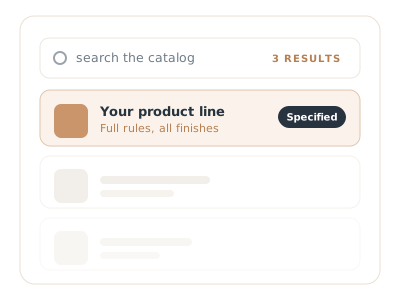
Your product isn't there to be found.
Picture a designer on a Tuesday afternoon, building out a floor plan for a project. They need [insert your products]. They open CET, browse what’s available, and spec the first product that’s easy to work with. Yours would have been perfect for the project. But they never saw it.
That’s not a hypothetical. That’s happening right now, on projects you’ll never hear about.
Something went wrong
Rush order neededMargins lost
Already on CET
An extension that almost works still doesn't work.
Same designer. Different Tuesday. They heard your extension was released, so they install it. They open it, try a configuration, and struggle. They leave it.
That’s the last time they try. Not because they decided against you — but because their time is worth more than troubleshooting software that should just work.
Thirty seconds. That’s what you get. We build for that moment.
A designer or engineer shouldn't have to know how your product works to sell it correctly. That's the software's job.
We've spent nine years inside other people's product logic.
If you’ve been through an extension build before, you know the real cost isn’t the invoice. It’s the year after — your team explaining workarounds, your users losing confidence, your budget going to maintenance instead of the next thing. We build so the year after is the quiet one.
Where we came from
We came from inside Configura.
Tim Deemter spent nearly ten years at Configura building and leading CET extension development before founding PlatinumEdge in 2017. CET extensions are the only thing we build.
The team
Seventeen people.
One dog.
A small team in Grand Rapids, MI. Come see how the work gets done.
Since 2017
Building CET extensions is the only thing we do.
85,000+ lines
Foundation code your extension inherits on day one.
86 product lines
Shipped for manufacturers including KI Aristotle and Teknion AI Healthcare.
What's inside every extension
What users see
a tool that just works
Edge cases
scenarios nobody thought to test
Rules logic
every constraint your product has — coded
PES foundation layer
the code you inherit on day one
85,000+ lines
Your extension has to hold up on the worst day, not the demo day.
Offline. Mid-deadline. On the configuration nobody thought to test. A user who gets burned once does not come back for a second try.
Getting there means doing the work that doesn’t show: understanding your product the way your best engineer understands it, building the logic in rather than around it, and designing for the moment nobody anticipated. That moment is the one that decides whether a user trusts your extension or quietly stops opening it.
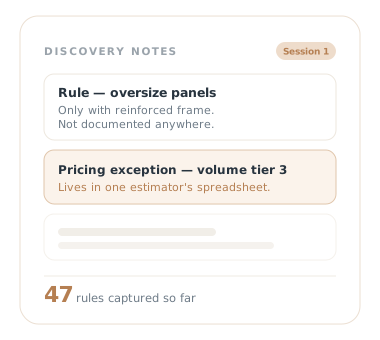
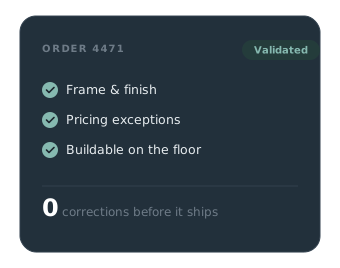
A working session with your engineers. We pull the rules out of their heads, including the pricing exceptions and the configurations nobody ever wrote down. We ask until there is nothing left to uncover, and we start with the product that needs to be in CET first.
Weeks 2–X
We build it. You break it.
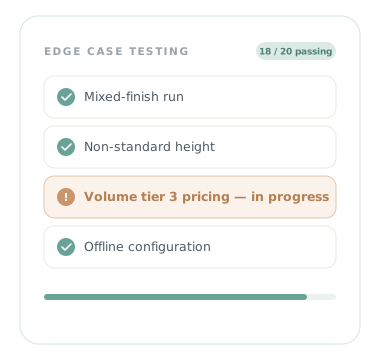
We build against your actual product, not a demo. Then you test it on the configurations that have always caused problems. Edge cases, exceptions, the ones your team navigates by instinct. Nothing ships until it holds.
Launch and ongoing
You launch, and we stay on.
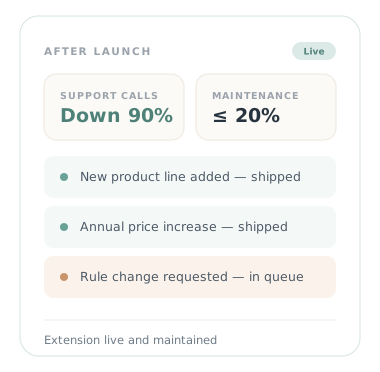
Your users configure your product without calling anyone. Orders come in clean, and your team stops being the safety net between the software and the factory floor. New products, price increases, and new rules are handled too. Most clients spend 20% or less of their budget on maintenance.
Internal teams stop quietly fixing output before it goes out the door.
Higher adoption.
When the tool works, users reach for it instead of working around it.
You stop doing the work.
Users specify your product without you in the room. That scales. You don’t have to — and overhead doesn’t have to grow for results to.
When CET finally reflects how your business works.
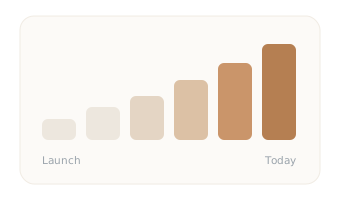
A few hundred users → 4,500
Adoption that compounds.
One partner rebuilt their extension with us. Adoption didn’t just grow — it compounded, and it hasn’t stopped.
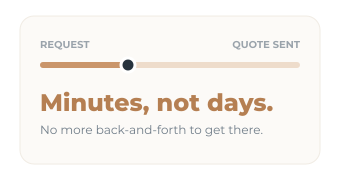
80% faster
Time back, every day.
That’s not a user experience win. That’s your team’s time, your users’ time, and your order cycle — all moving faster.
“Sales took off.”
Users keep asking for more.
A partner’s words, not ours. When the tool works, users don’t work around it — they reach for it.
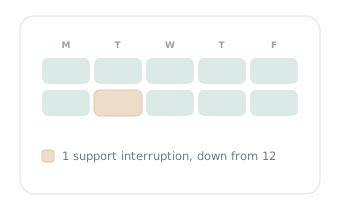
Zero complaints.
Just a growing wish list.
One partner hasn’t fielded a single complaint since launch. Their inbox has feature requests instead of support tickets and most customers spend 20% or less of their budget on maintenance.
"Their experience showed at every step. The team brought practical ideas and industry insight that helped us make smarter decisions and clearly define what we should — and shouldn't — do."